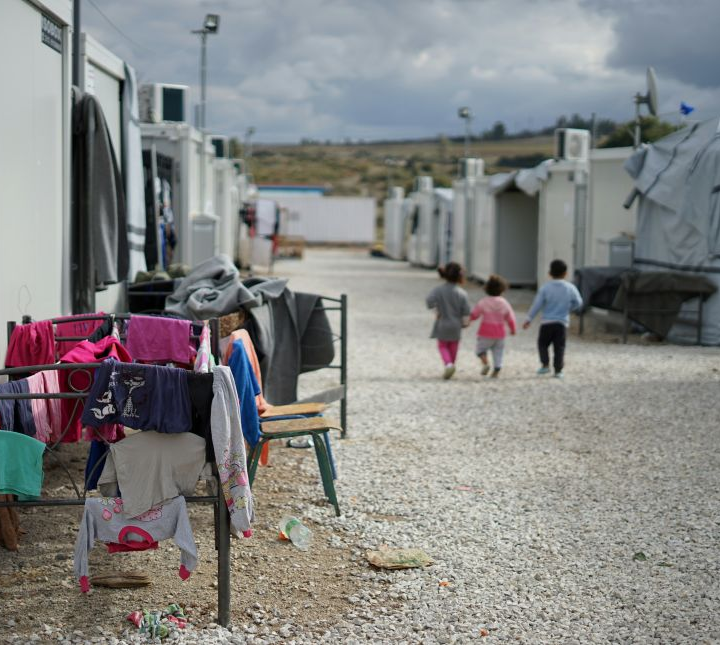
Statelessness and Children’s Human Right on Education – Violations in the case of Greece

Stateless children in Greece, especially those living in reception and identification centres, face systemic violations of their right to education. This right, protected internationally by the Convention of the Rights of the Child, is diminished in the form of exclusion from society and from the institutions responsible for children’s protection. Despite formal recognition of education as a right under international and national conventions, stateless minors are excluded from educational opportunities by legal and administrative gaps, as the state prioritizes border protection over the protection of children, reinforcing systemic injustice. This essay examines not only the legal framework but also the practical realities, psychosocial consequences and the value of stateless children’s access to early childhood education in Greece.
Under Greek law, the right to education is theoretically protected for minors who are applicants for international protection or children of people who are applicants, without any delay. This description, however, ignores stateless minors who cannot obtain their refugee status. Law 4939/2022 allows access to education for these children, yet its implementation faces major obstacles. One of them is the Ministerial Decision 2099/2020 that allows registration of children who are applicants for refugee status or are children of people who are applicants for refugee status, excluding stateless children who cannot obtain such status. Thus, children remain excluded under an inconsistent legal framework that does not consider the best interests of children, even during their detention, and instead creates a system filled with protection gaps.
Furthermore, there is clear institutional indifference to stateless children’s psychosocial development, a circumstance that intensifies the violation of their protection. Researchers in the field have documented cases of depression, anxiety and post-traumatic stress disorder among children living in reception and detention centres, as legal uncertainty fosters social rejection. Stateless children without the chance to obtain refugee status can be victims of pushbacks, or “readmission” practices, without the normal procedure and are thus held in informal detention zones sometimes referred to as “black sites”, deprived of their right to act legally and request asylum and thus have the chance for development through education. Children can understand the difficult situation they live in, and this deprivation of a legal identity can render them invisible in Greek society. Without a stable environment, relations and safe spaces, children cannot be properly developed unless they manage to create an atmosphere of self-reliance, as they do not have the chance to thrive.
Moreover, the state seems to place the burden of handling this situation onto NGOs and teachers, without essential support, often leaving them to accommodate educational needs on their own, or by international programs produced by the education community, not the state. This leads to the creation of a system that needs to be further supported by volunteers through NGO posts following a global trend, as the Greek state does not provide teaching positions for classrooms of stateless children (as mentioned above), or rely on a self-reliance system. As a result, the psychosocial effect of this situation affects both the children and the adults, who are constantly under a state of professional exhaustion and can provide their students only with a superficial psychosocial form of support.
In addition, even though the Greek legislature describes the immediate enrolment of children in early childhood education and the beginning of classes for detained children, these classes follow the same official education programs that are in place for all children in Greece. As it was mentioned above, the right to education for stateless minors is not mentioned explicitly in the Greek legislature and one can argue that it may be discussed within the decisions made for education in reception and detention centres. That education is led mostly through NGO volunteers and professionals who, according to the legal texts, must provide access to education and other activities, yet it does not give guidance on what and how to do that. Thus, teachers face severe challenges, as there is no official education plan for refugee education in Greece. To provide quality instruction, they must rely on international curricula or design their own. The state exhibits institutional indifference similar to that of other countries, treating refugees as burdens or even criminals: without legal documentation they cannot prove their existence and claim access to their rights, such as education.
To properly support the needs of stateless minors in Greece, policymakers and specialists must put at the heart of education the children as agents of political and social change, rather than a problem that needs to be solved. Early childhood education, whether it is formal or informal, is a critical factor for the development of resilience and social inclusion of children with this marginalized background. It facilitates cognitive and social development and provides psychological security, language knowledge, civic participation and sense of belonging in a safe environment from the moment they enter an educational institution extending into their adult and professional lives. When these opportunities are absent, children are deprived of their chance to integrate successfully in a foreign society for them, revealing the failure of the broader social compact. This is particularly important for children with stateless status whose lack of national identity already creates tremendous obstacles in certain legal pathways and education remains the first avenue through which they can claim their agency and let their voices be heard.
The above shows the need for reform and change. It is essential to reconsider the current education policy, to actively support stateless children, whether they have refugee status or not and be in accordance with directives that go beyond EU mechanisms, which often perpetuate legal invisibility. In addition, focus should include psychosocial support of the minors along with the educators involved with their education and broad support. Education cannot be limited to just enrolment – when that is possible – but actual inclusion with culturally sensitive intervention programs and provide support the children deserve.
In sum, these three strands – legal invisibility, psychosocial obstacles and access to early childhood education – showcase a clear path that the Greek state now follows: limited access to fundamental rights and failure to secure them in practice, producing social harm and injustice. Empirical and legal arguments call for immediate reforms and the creation of stable mechanisms that recognize the protection of stateless children. Only policies that place the child’s best interest in the centre can break the cycle of injustice and create a genuinely inclusive educational environment.


0 Comments
Add new comment